
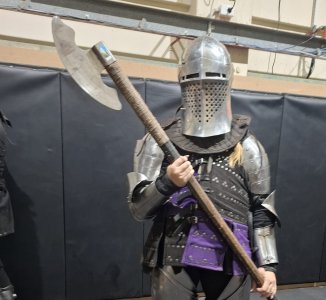
What does “buhurt” mean?
Historically, buhurt referred to a form of group tournament combat. Today, the name is used for a modern sport in which teams of armoured fighters compete inside a fenced combat area known as the list.
Modern buhurt combines:
- Full-contact weapon strikes with regulated, blunt steel weapons
- Standing grappling, throws and takedowns
- Team positioning and communication
- Historically based armour and equipment
- Modern sporting rules, trained marshals and equipment checks
It is sometimes described as MMA in armour, although buhurt has its own rules, equipment, tactics and competition formats.
How does a buhurt fight work?
In a team buhurt, both sides begin with all fighters standing. The basic objective is to put opposing fighters on the ground while keeping your own teammates upright.
A fighter is normally considered down when a third point of contact touches the ground in addition to both feet. That could be a hand, knee, weapon or another part of the body. Once down, the fighter stops participating in that round.
Fighters may use legal weapon strikes, shield pressure, clinching, trips, throws and coordinated team takedowns. Thrusting with weapons and attacks to prohibited areas are not allowed. The full rules also regulate armour coverage, permitted techniques, weapon dimensions and the responsibilities of competitors and marshals.
Common team categories include 3-v-3, 5-v-5, 12-v-12 and larger mass battles. Tournament formats vary, but rounds generally continue until one side has no fighters left standing or a decisive numerical advantage is reached under the applicable rules.
Always consult the current Buhurt International rules and the requirements of the event you are entering.
Buhurt, duelling and outrance
Armoured combat includes several related disciplines. They reward different skills and should not be treated as interchangeable.
| Discipline | How it works | What matters most |
|---|---|---|
| Team buhurt | Teams use legal strikes, grappling and takedowns to put opponents on the ground. | Teamwork, balance, positioning, endurance and awareness |
| Duelling | One fighter faces another and scores clean, accepted weapon strikes. Common categories include sword and shield, sword and buckler, longsword and polearm. | Timing, accuracy, distance, defence and weapon control |
| Outrance | A one-on-one full-contact format combining weapon strikes, grappling and other permitted combat techniques. | Conditioning, adaptability, striking and grappling |
| Soft-kit training | Fighters practise with padded equipment rather than steel armour and weapons. | Safe skill development, movement, tactics and fitness |
Many Australian fighters train across more than one discipline, while others specialise.
Is buhurt the same as HEMA or medieval reenactment?
No. They share an interest in historical weapons and martial culture, but their objectives are different.
Buhurt is a modern full-contact competitive sport fought in protective steel armour. Team combat includes sustained contact, grappling and takedowns.
HEMA—Historical European Martial Arts—focuses on reconstructing and practising documented historical fighting systems. Competitions commonly use modern protective equipment and rules designed around technical exchanges and scoring.
Medieval reenactment focuses primarily on interpreting and presenting historical life, crafts, clothing, military activity or staged combat. Some people participate in more than one of these communities, but joining one does not automatically prepare someone for the rules and physical demands of another.
Do I need armour to start buhurt?
No—and buying armour before joining a club is one of the most expensive mistakes a beginner can make.
New fighters normally begin with fitness, movement, grappling, weapon-control drills and soft-kit training. This lets you learn the fundamentals without first committing to a complete suit of steel armour.
An experienced club can help you understand:
- Which competition discipline suits you
- What historical period and region your armour will represent
- Correct measurements and fit
- Current armour and weapon rules
- Which makers have a reliable record
- What equipment should be purchased first
- Which second-hand items are safe to consider
- Australian laws affecting ownership, storage and transport
Poorly fitted or non-compliant equipment can be uncomfortable, unsafe and unusable at competition. Speak to your club’s armourers and experienced fighters before placing an order.
How much does buhurt armour cost in Australia?
A complete competition-ready kit is a serious purchase and can cost several thousand Australian dollars once armour, helmet, gauntlets, padding, footwear, weapons, freight and adjustments are included.
The total varies considerably according to:
- New, used or club-owned equipment
- The armour style and level of decoration
- Custom sizing and construction
- Freight, import charges and exchange rates
- The number of disciplines you intend to enter
- Repairs, maintenance and future upgrades
Do not treat the cheapest online listing as the cheapest path into the sport. Incorrect sizing, weak construction or equipment that fails authenticity and safety checks can cost more to replace than buying suitable gear once.
Start training first. Most beginners build their kit gradually with guidance from their club, and some clubs can provide or help source loan equipment for supervised training.
Are buhurt weapons sharp?
No. Competition weapons are steel, but their striking edges and points must be rounded and must comply with dimensional and weight requirements. They are made for controlled sporting use—not cutting or stabbing.
That does not make them harmless. Buhurt is an inherently high-impact activity, which is why armour coverage, equipment inspection, prohibited targets, trained supervision and progressive instruction matter.
Weapons commonly seen in Australian buhurt include:
- Arming swords and falchions
- Longswords
- One-handed and two-handed axes
- Polearms
- Maces where legally permitted
- Shields and bucklers
Weapon laws differ between Australian states and territories. Requirements may affect purchase, possession, transport and use. Check the current advice from the Australian Medieval Combat Federation and the relevant authority in your state before buying or transporting equipment.
Is buhurt safe?
Buhurt is not risk-free. It involves hard physical contact, heavy equipment, weapon strikes, grappling and falls. Injuries can occur even when participants follow the rules.
Risk is managed through measures including:
- Progressive training before steel competition
- Regulated armour and weapon standards
- Pre-fight equipment checks
- Prohibited strikes and techniques
- Marshals controlling each bout
- Medical coverage at organised competitions
- Stop commands and removal of damaged equipment
- Fitness, balance and falling practice
The best safety decision a beginner can make is to train through an established club rather than trying to reproduce online fight footage without instruction.
How to start buhurt in Australia
1. Find a recognised club
Use the AMCF Club Finder to locate current Australian clubs. Club locations and contact details can change, so the federation’s live directory is more reliable than an old list copied onto another website.
2. Contact the club before attending
Tell them that you are new and ask which session is intended for beginners. Confirm what clothing, footwear and protective equipment you should bring and whether loan soft kit is available.
3. Attend a beginner or soft-kit session
Expect to work on stance, movement, safe weapon handling, basic striking, balance, clinching, takedown defence and conditioning. You should not be placed directly into uncontrolled steel fighting.
4. Build the required fitness and skills
You do not need to arrive looking like a professional athlete. Consistent training develops the sport-specific fitness you need: short bursts of effort, grip strength, balance, recovery under load and the ability to make decisions while tired.
5. Plan your armour with experienced help
Once you know that you want to continue, your club can help you measure, choose a suitable harness and avoid expensive mistakes. Armour should be treated as protective sporting equipment, not simply a costume.
6. Complete the required membership and competition steps
Your club will explain its membership, insurance, equipment checks and any federation requirements that apply before steel training or competition.
Training with Tyr’s Warriors in Toowoomba
Tyr’s Warriors is an established, family-oriented buhurt and armoured-combat club based in Toowoomba, Queensland. Founded in 2019, the club has grown into one of Australia’s larger active buhurt communities and includes nationally and internationally experienced fighters.
Training covers the main parts of the sport rather than throwing beginners straight into steel. Depending on the current timetable, sessions include:
- Fitness and conditioning
- Beginner-friendly soft-kit training
- Women’s training through Tyr’s Valkyries
- Steel-armour buhurt
- Armoured duelling
- Open-mat practice
The club welcomes different fitness levels and experience levels. New members can learn the sport, improve general fitness, compete if they choose and become part of an active team and event community.
Training centre: 6/57 Brook Street, Toowoomba
QLD, Australia
Email: info@tyrswarriors.club
Current timetable: View Tyr’s Warriors training
information
Ready to begin: View trial and
membership options
Watch buhurt live in Queensland
Tyr’s Warriors also produces Fight Knight, a live armoured-combat event in Toowoomba. It gives spectators a close view of duels, outrance and team buhurts in a purpose-built show environment.
If you are interested in the sport but not ready to train, attending an event is an excellent way to see the equipment, meet fighters and understand the difference between the disciplines.
Frequently asked questions
Can complete beginners try buhurt?
Yes. Most clubs teach beginners from the fundamentals. Previous experience in martial arts, rugby, wrestling or strength sports can help, but it is not required.
Do I need to be extremely fit before my first session?
No. Start at your current level and build gradually. Buhurt training develops strength, cardiovascular fitness, balance, coordination and confidence over time.
Can women compete in buhurt?
Yes. Women train and compete in Australian buhurt across team and individual disciplines. Tyr’s Warriors supports a dedicated women’s program through Tyr’s Valkyries as well as broader club training.
Can children do buhurt?
Full-contact steel competition has age and participation requirements. Some clubs may offer age-appropriate fitness or soft-kit activities. Contact the individual club to confirm its current junior policy rather than assuming a child can enter an adult session.
Is buhurt staged?
No. Competition outcomes are not choreographed. Fighters train and compete under sporting rules, and the contact, takedowns and physical demands are real.
Can I train without competing?
Yes. Many members value the fitness, skills and community without making competition their main goal. Speak with your club about the training pathways available.
How heavy is buhurt armour?
The total varies with the fighter and armour style, but a complete harness commonly weighs several tens of kilograms. Good fit and weight distribution are as important as the raw number on a scale.
Where can I find official Australian buhurt rules?
The Australian Medieval Combat Federation provides Australian sport information and links to the current international rule documents. Always check the rules issued for the particular tournament you are entering.